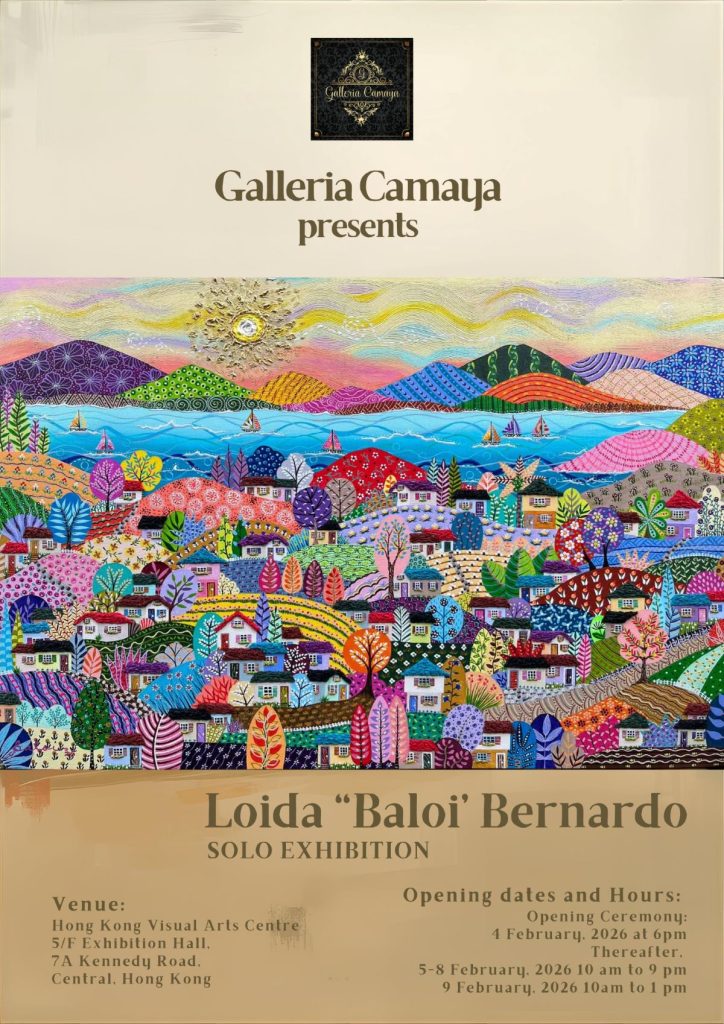
In Loida “Baloi” Bernardo’s hands, the landscape is not a destination—it is a sensation. A contemporary Filipino artist working in acrylic and mixed media, Bernardo approaches the natural world obliquely, refusing the familiar comforts of literal depiction. She does not paint what a place looks like. She paints what it does to you: the warmth that pools in the chest at golden hour, the hush that settles over a town under moonlight, the soft exhale that follows rain.
Encountered through the Filipino art communities where she shares her work and accepts commissions, Bernardo’s paintings feel both intimate and assured, works made for viewers who crave not spectacle but recognition. She belongs to a growing wave of artists who understand that the most honest record of experience is often emotional, not photographic. In her practice, landscape becomes memory, mood, and inner weather, translated into color.
Color as the Most Direct Language
The engine of Bernardo’s work is a clear, quietly radical premise: color speaks to emotion without requiring explanation. Where traditional landscape painting might ask, How do I render this sky accurately? Bernardo’s paintings begin with a different question: What colors carry the warmth, nostalgia, and fleeting beauty of what I felt? That shift, away from description and toward embodiment, changes everything. The canvas becomes less a window and more a resonant surface, tuned to feeling.
Her titles make the intention explicit. Works such as “Golden Hour,” “Bright Night,” “Blessed Morning,” and “Above the Clouds” operate less as coordinates than as invitations. They do not promise a specific location; they promise an emotional state. “Golden Hour,” for instance, is not a sunset presented for verification. It is an atmosphere composed, warm golds, soft purples, gentle transitions. aimed at the tenderness and bitter sweetness of light that is already leaving. You don’t “identify” the scene so much as you inhabit it.
This is the quiet power of Bernardo’s abstraction: it accepts what many viewers already know but rarely articulate, that landscapes matter because they move us. A mountain range can awaken awe and smallness. A moonlit street can suggest solitude, romance, or both. Water can soothe. Bernardo does not illustrate these responses; she builds them, letting color do the work language cannot.
Acrylic, Mixed Media, and a Sense of Surface
Bernardo works primarily with acrylic on canvas, often incorporating mixed media to enrich the surface. Acrylic’s quick-drying nature lends itself to her method: layers can accumulate without delay, allowing nuanced relationships between hues to develop, one color pressing forward, another receding, and a third binding the field together. The mixed-media elements, used to create texture and depth, add a physical, almost relief sculpture dimension to the paintings. They hold the eye longer, as one lingers on those tiny details of colorful patterns.
Scale, too, appears considered rather than incidental. Bernardo moves between intimate 20-inch square works and larger 2×3 foot pieces, and the shift matters. The smaller paintings encourage closeness, an almost private exchange. The larger works ask for the body’s attention; they become more immersive, more commanding, more like environments than objects. She often uses box-type canvas, a presentation choice that gives the work a clean, three-dimensional presence and a gallery-ready finish without reliance on framing. It’s a practical decision, yes, but it also signals an artist attentive to how a painting meets the world.
The Poetry of Harmony
One of the most striking qualities across Bernardo’s practice is her recurring emphasis on harmony, a concept that appears in titles and is reinforced by her compositional instincts. Her abstraction is not combative. It does not lean on harsh dissonance or shock to make its point. Instead, it seeks balance: warm tones conversing with cool ones, saturated passages eased by quieter neighbors, transitions handled with care rather than spectacle.
The effect is meditative. In many contemporary abstractions, color becomes a battleground; in Bernardo’s paintings, it becomes choreography. The hues “dance” rather than clash, and the viewer is invited to slow down, to feel rather than react. This is not a retreat from intensity so much as a belief in a different kind of intensity: the deep, sustained emotional impact of a painting that does not shout.
Contemporary Landscape as Inner Experience
Bernardo’s work also reads as distinctly of the 21st century. If earlier landscape traditions sought mastery over the visible world, contemporary painters increasingly turn inward, recognizing that photography already outperforms painting at description. Bernardo’s landscapes align with this evolution: a landscape is no longer only a place outside the self, but a state within it made visible through form and color.
Within the context of Filipino art communities, especially among women artists exploring abstraction, her practice participates in both local conversation and broader contemporary discourse: what can abstraction carry, and how directly can it communicate? Bernardo’s answer is confident and consistent. Abstraction, in her hands, is not a refusal of meaning. It is a distilled form of meaning.
Why This Approach Matters
Bernardo’s r practice matters for how it moves through the world. Working primarily through online platforms and community networks, Bernardo demonstrates that serious artistic vision can flourish outside traditional gatekeeping structures. The consistency of her production, her technical control, and the evident interest from collectors point to an audience hungry for art that communicates emotionally, art that makes space for contemplation and recognizes contemporary ways of encountering both painting and place.
A Personal Vision
At its essence, Loida Bernardo’s abstract landscape practice is an act of translation: light, weather, time of day, memory, and love rendered not as objects but as experiences. Each canvas asks a fundamental questionm How do I paint what I feel, and answers it with disciplined lyricism: through color, through balance, through harmony.
To stand before works like “Golden Hour,” “Bright Night,” or “Above the Clouds” is to meet an artist intent on making emotion legible without reducing it. Bernardo trusts that viewers, too, have lived inside a golden hour, a moonlit street, and the relief after rain, and that color, arranged with care, can return them there.
The local art aficionados and the Filipino community in HK will have an opportunity to stand before several of these large evocative landscape paintings during Loida “Baloi” Bernardo’s solo show here at the Hong Kong Visual Arts Centre from February 4 to 9.
The solo exhibition is organized by Gail Hills of Galleria Camaya and curated by Hong Kong-based artist Jun Canete.
Venue: Hong Kong Visual Arts Centre, 5F Exhibition Hall, 7A Kennedy Road, Central, Hong Kong
Opening ceremony: 4 February, 2026 6pm to 9 pm
5-8 February, 2026 10 am to 9 pm; 9 February, 2026 10am to 1 pm
About the author: Rodolfo Canete Jr. is a Hong Kong-based Filipino journalist and self-taught multidisciplinary artist who also paint in acrylic.