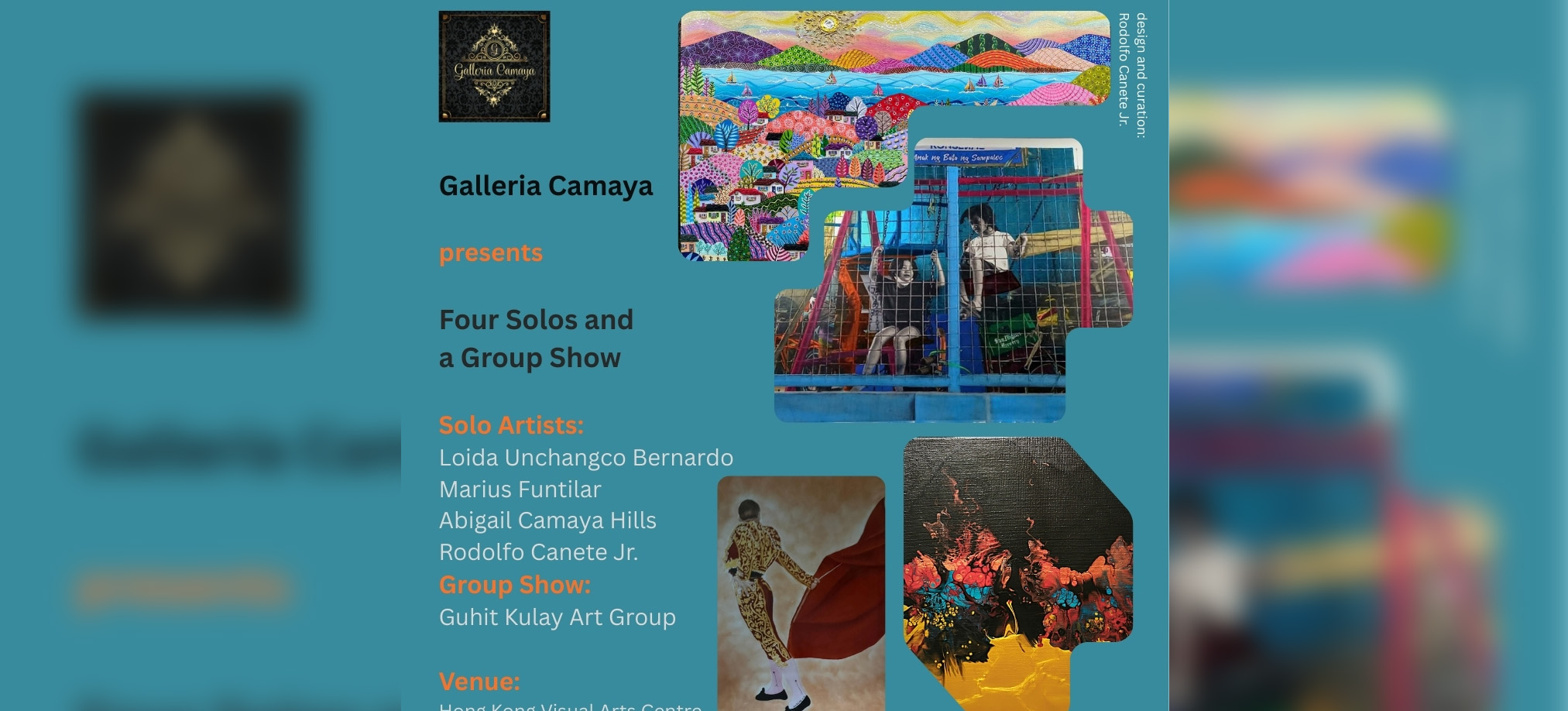
Guhit Kulay, a collective of Filipino migrant workers dedicated to fostering creativity and community through art, will present a group exhibition titled “Bridges of Care, Threads of Home: Guhit Kulay at HKVAC” at the prestigious Hong Kong Visual Arts Centre from February 4 to 9, 2026. The show is organized by Galleria Camaya.
At the heart of the “Bridges of Care, Threads of Home: Guhit Kulay at HKVAC” exhibition is a proposition that feels both simple and quietly radical in Hong Kong: that the people whose labour sustains daily life also sustain forms of vision, memory, and cultural making. Guhit Kulay, a collective composed largely of Filipino domestic helpers in Hong Kong who are also practicing artists, presents works that move beyond autobiography or “inspiration” as a frame. Instead, these paintings and textile-based works insist on artistic authorship: images built with discipline, tenderness, and an acute understanding of how identity is carried across distance.
Across oil, acrylic, palette-knife painting, thread and fabric assemblage, and watercolor, the exhibition gathers around three interwoven themes: care as an ethic, heritage as a living material, and home as a shifting, constructed feeling. Together, these works form a chorus of perspectives shaped by migration, by the intimacy of domestic space, and by the ongoing negotiation between private longing and public life in a global city.
Several works locate care not as sentiment, but as a gesture—a practice with weight and consequence. In Dong Eludo’s mano, the Filipino tradition of pagmamano becomes an image of intergenerational continuity: respect enacted through touch, a cultural value transmitted through the body. In Jonalyn Macalalad Molina’s Aruga, hands cradle a small bird with a restraint that reads as moral clarity—strength defined not by control, but by protection. Jacklyn Evangelista’s The Art of Positive Mirroring extends this idea into relationship: mirroring as an active choice to meet another person with attention, to reflect feeling back with care, and to build trust through repeated tenderness. In these works, care is neither invisible nor incidental; it is pictured as skill, responsibility, and power.
If care is one anchor, cultural transmission is another. Cristina B. Cayat’s Thread of Heritage, composed of cut indigenous fabrics from the Cordilleras, foregrounds textiles as living archives—patterns as repositories of ancestry, place, and community knowledge. The work does not treat tradition as a static relic; it re-situates indigenous material culture within a contemporary visual language, asserting continuity in an era of cultural flattening. This commitment resonates with paintings that similarly honour lineage: Angie Brotamonte’s Threads of Heritage celebrates Philippine textile motifs through paint, while Leizl Tam‑og’s Legacy of Tradition turns toward Cordilleran ritual and intergenerational learning—heritage not merely “remembered,” but actively passed on.
In a parallel register, the exhibition returns repeatedly to womanhood as cultural bearer and historical force. Lenin Galvez Flores’ Lakambini—rendered through a mosaic-like method—suggests that identity is assembled from countless fragments: lived experiences, struggles, joys, and acts of endurance. Arlene Miguel Madriaga’s Filipina in her Filipiniana places traditional dress within a vivid natural surround, making heritage tactile and luminous rather than ceremonial. Here, the Filipina figure is not a nostalgic emblem; she is present-tense, upright, and self-possessed—heritage embodied, not performed for an outside gaze.
Throughout the exhibition, “home” appears as a complex horizon rather than a single destination. Maricel Agsaoay’s The Path of the Sun‑Leaf imagines return as a movement toward light—an orientation, a guiding warmth. Rochelle Razon’s Going Home frames home through motion and city geometry, acknowledging the bittersweet truth that one cannot always return to what was left behind unchanged. Maria Christina Anire’s Karera ng Buhay (Life’s Race), set against a bustling urban cityscape with a tram cutting through the scene, speaks directly to metropolitan tempo—the pressure to hurry, to survive, to keep pace—while asking what we lose when we forget to look.
Nature in these works is not merely backdrop; it is witness, refuge, and responsibility. Iluminada Asis Palcorin’s Silent Witness treats the ocean as both solace and force—beautiful, enduring, and vulnerable to human neglect—inviting viewers into accountability as much as contemplation. Works in progress such as Jhoan Estrera’s Soaring Spirit (the Philippine eagle amid tropical foliage) and Marichel L. Tomines’ Waling‑waling (the storied orchid) hold biodiversity as national memory and shared inheritance. Cecilia Eduarte’s Magnolia Blossoms offers another kind of resilience: quiet perseverance rendered through flowering.
Presented at the Hong Kong Visual Arts Centre, these artworks ask to be encountered not through a lens of exception, “artists despite”, but through the fuller truth of Hong Kong’s cultural ecology: that creativity thrives in the same city where care work, migration, aspiration, and sacrifice intertwine. Guhit Kulay’s exhibition is a space of visibility, yes, but more importantly a space of artistic agency. Each work is a bridge, between generations, between places, between private interior life and public form, built from colour, touch, pattern, and patient attention.
The “Bridges of Care, Threads of Home: Guhit Kulay at HKVAC” group exhibition is organized and presented by Galleria Camaya and curated by Rodolfo Canete Jr.
Venue: Hong Kong Visual Arts Centre, 5F Exhibition Hall, 7A Kennedy Road, Central, Hong Kong
Opening ceremony: 4 February, 2026 6pm to 9 pm
5-8 February, 2026 10 am to 9 pm; 9 February, 2026 10am to 1 pm
About the author: Rodolfo Canete Jr. is a Hong Kong-based Filipino journalist, curator and self-taught multidisciplinary artist.