Marius Cornelius Funtilar, professionally known as “Marius Black,” has carved a unique niche in the Philippine art scene by bridging two distinct worlds: the stylized aesthetics of Japanese ukiyo-e and the gritty, documentary-style realities of urban Manila. A painter, illustrator, and poet, Funtilar views his practice as a long-running project to mythologize “real Manila,” confronting the city’s social truths with a compelling blend of tenderness, narrative depth, and graphic stylization.
Background and Artistic Trajectory
A 2007 cum laude Fine Arts graduate from the University of Santo Tomas, Funtilar’s artistic foundation was built on a childhood immersion in comics and cartoons. This influence allowed him to move fluidly between mediums, transitioning from painting to self-published art books and poetry, often in collaboration with his wife and fellow artist, Guada. Over the past decade, he has established himself as a “traditional artist and storyteller,” a reputation solidified by his signature Manila Ukiyo-e series and solo exhibitions such as Manila Synesthesia at Altro Mondo.
The Manila Ukiyo-e Series
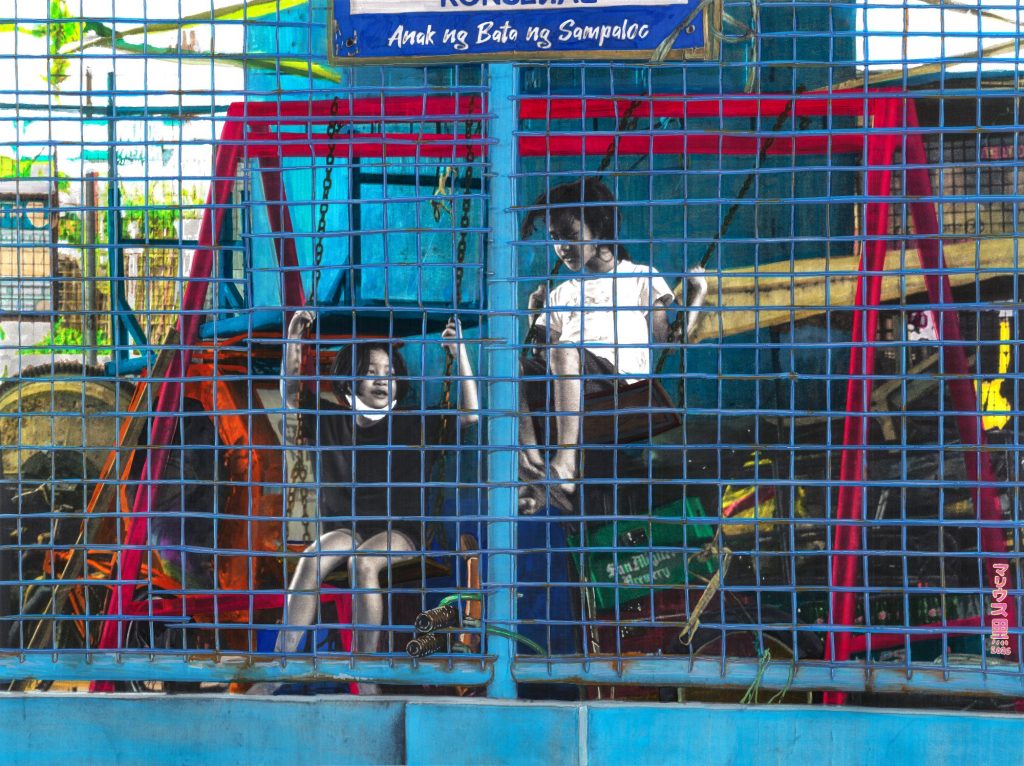
At the heart of Funtilar’s body of work is Manila Ukiyo-e, a series that reimagines the “floating world” of Edo-period Japan within the context of contemporary Philippines. He adopts the visual conventions of the genre, simplified lines, flat patterns, and bold contours, but radically shifts the subject matter. Instead of kimonos and kabuki actors, his canvases feature tricycle drivers, sari-sari stores, and informal settlements. The result is a hybrid visual language where the surface reads as graphic and historical, but the environmental details are constructed from keen observation and street photography.
Themes of Humanity and the Overlooked
Funtilar’s work is driven by a desire to uncover beauty in the mundane and the ignored. Through pieces like Lola Move, Xixa, and Vagabond, he directs the viewer’s gaze toward the elderly, the homeless, and the marginalized, subjects often edited out of idealized depictions of the city.
Crucially, he seeks to humanize these figures through narrative. Many of his paintings are accompanied by short stories or poems that frame the subjects as protagonists with rich inner lives rather than anonymous social types. This approach echoes the narrative function of traditional ukiyo-e, turning the streets of Manila into a stage for contemporary storytelling.
Sensory Experience and Interpretation
In exhibitions like Manila Synesthesia, Funtilar extends his concept beyond the visual. He uses the metaphor of synesthesia, the crossing of senses, to suggest that a painting can trigger multiple sensations, turning urban fragments into multi-sensory experiences. He does not aim for a single, sanctioned interpretation of his work; rather, he encourages viewers to project their own emotions and experiences onto the scenes, allowing for a plural reading of the city.
Social Context and Critical Reception
Funtilar occupies a space between street-level social realism, indie comics, and globalized pop aesthetics. This positioning makes his work highly accessible to digital audiences, particularly on platforms like YouTube and Instagram, where he documents his process.
However, his work also engages with complex ethical questions. While some critics have debated the fine line between empathy and the romanticization of poverty—often termed “poverty porn”—his supporters argue that his art challenges the viewer to confront social neglect. Regardless of the perspective, Funtilar’s consistent exploration of the city has contributed a distinct visual vocabulary to contemporary Filipino art, making Manila Ukiyo-e a recognizable and significant micro-genre in local culture.
Marius Black’s Multi-sensory Manila Arrives in Hong Kong
Marius Black will have his first solo exhibition in Hong Kong titled “Color of Life” at the Hong Kong Visual Arts Centre. For this exhibition, Marius draws inspiration from the antiquated practice of hand-colored photography, a technique employed by Japanese photographers between 1860 and 1899, who meticulously applied pigment to monochromatic prints in an era predating chromatic film.
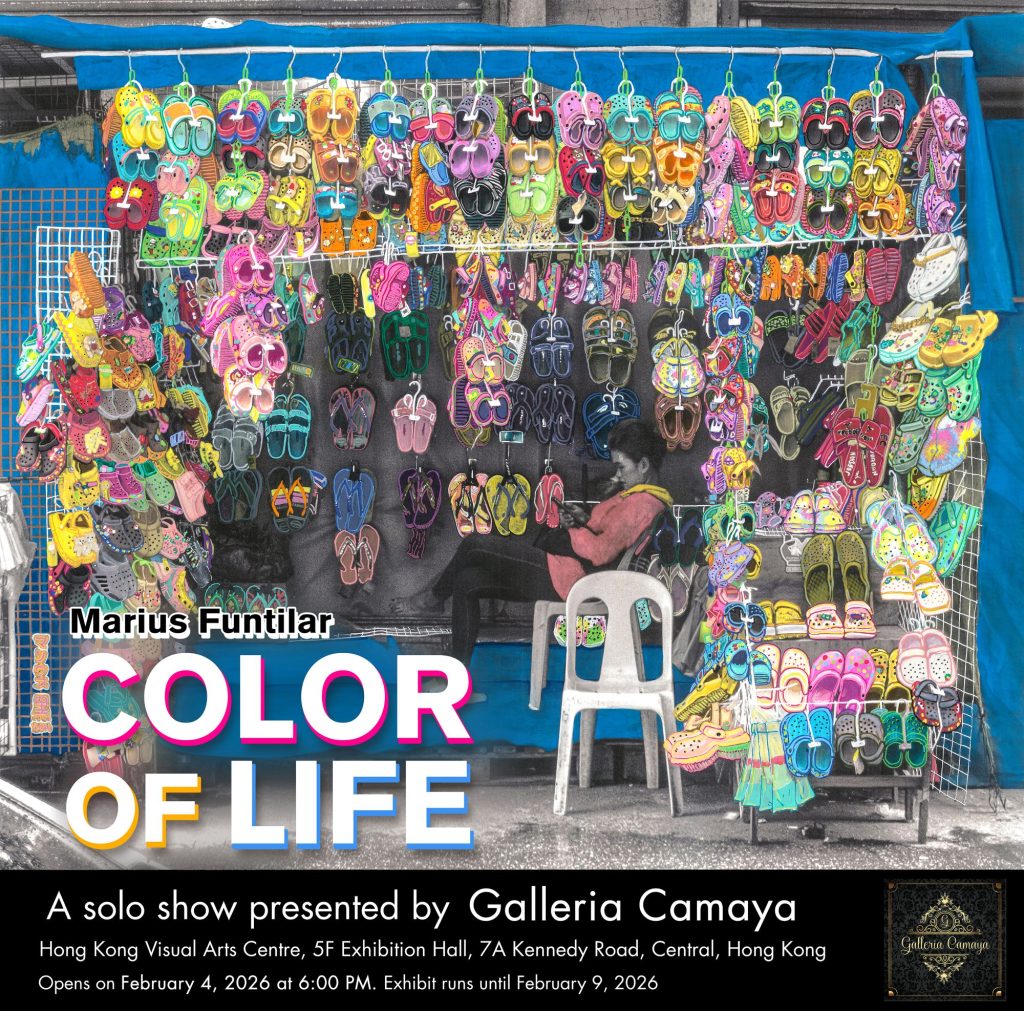
Much like analog photography, this historical process retains a distinctive aesthetic quality that evokes nostalgia for a bygone medium. Marius seeks to reinterpret this colorization sensibility for contemporary audiences, offering a transformed perspective on his subjects.
The solo exhibition is organized by Gail Hills of Galleria Camaya.
Venue: Hong Kong Visual Arts Centre, 5F Exhibition Hall, 7A Kennedy Road, Central, Hong Kong
Opening ceremony: 4 February, 2026 6pm to 9 pm
5-8 February, 2026 10 am to 9 pm; 9 February, 2026 10am to 1 pm
About the author: Rodolfo Canete Jr. is a Hong Kong-based Filipino journalist and self-taught multidisciplinary artist.